Saturday, September 28, 2013

Iron Sheets for Kising'a

Our visits to Tanzania usually spark some activity on Church projects.  This is partly because we can bring some financial help and partly because they like to proudly show some progress when we visit to celebrate together.  This trip is no exception.  I texted Pastor Wihale that I was coming a few weeks before I left and they have been busy framing the roof for the new main Church building in Kising'a.  The building site is a beautiful location on a hillside overlooking many homes of Kising'a.  It was just a foundation ring when we visited in 2007 and we have been watching the walls grow over the years.

The only materials they need from the outside are cement, iron sheets, and nails.  They make their own bricks and cut their own boards.  They need iron sheets now to complete the roof.  I met Pastor Wihale and Mponzi, the Parish treasurer, to buy 80 iron sheets and some nails and arrange transport to Kising'a.  This meant starting at the bank to withdraw some construction funds that had been transferred to the parish account from our BKB account for Kising'a.  This took about an hour with a line of 30 people and only one or two tellers at different points during that hour.

 We hunted for a place that had Simba Duma (Lasting Lion) iron sheets and Pastor Wihale called to arrange transport.  With all things arranged, we bought 75 iron sheets, 12 kg of nails, and 5 translucent sheets that provide natural lighting from the roof.   Kind of like the sky light in our Church at home but without the flies.

I had sent a few Kiswahili children's books home with Pastor Wihale when I met him last weekend and he said that the family gathered and were reading them last night.  Stephano is starting to read Kiswahili and Rushua was enjoying the pictures.  I will go to Kising'a on Friday Oct 11 and bring the rest of the books for the library.  I am really looking forward to showing them to children and seeing how they like them.  Asante to those who contributed for the library, I think this is going to be a great project.

Walking the church foundation in 2007

Video of men cutting boards in Kising'a from a previous visit.  Anyone want to trade their table saw for this?


Simba Dumu, "Lasting Lion" brand sheets

Translucent sheets for sky light, they cost 50,000 tsh (~$30) which is twice the iron sheets.
Me, Mponzi, and Pastor Wihale with sheets waiting for transport.

Wednesday, September 25, 2013

Mwangaza Workshop

The Mwangaza staff came down from Arusha to conduct a workshop for teachers from the Iringa Diocese schools.  Mwangaza is a Lutheran partnership for education that has developed a program for how to teach in Tanzanian Secondary Schools where students are learning English, the language of instruction, at the same time they are learning content.  24 teachers from 6 diocese schools are attending the week long workshop along with the new headmaster for Ipalamwa school which is scheduled to reopen in November.  Shepherd of the Valley Lutheran Church provided financial support for the workshop.  The conference is being held at Huruma Orphanage so we are supporting the orphanage as well as the teachers. 
Children on a rotating swing at the orphanage.

L2R Allen, the Mwangaza driver, John Kavishe, Thomas, a volunteer from MN, and Salome.  John and Salome are the Mwangaza instructors.


Mwangaza has adapted Sheltered Instruction Observation Protocol (SIOP) for Tanzanian schools by creating their own 118 page manual.  SIOP is a designed to teach students who are learning the language of instruction while they are in school.  In the US this approach is needed for immigrant students who may not speak English when they start school.  In Tanzania it is needed for almost everyone since they speak Kiswahili in primary school and must learn English when they start Secondary School.  The teachers estimate that 90% of the incoming students are in the Entering Stage of Language acquisition, which means a vocabulary of 0 - 500 words.  The only exception would be the few that come from an English medium primary school.  The picture below is a page from the Mwangaza book that describes this stage and strategies for teaching students.

Stage 1 Language Acquisition and Teaching Strategies
The Mwangaza approach incorporates language objectives into lesson plans for all subjects so all teachers become English teachers.  Many strategies for communicating with English learners have been presented as well as general learning strategies such as building background and connections with students experiences and techniques to enhance learning of lesson content.  I will bring a copy of the Mwangaza manual home with me.  The workshop runs from 8 AM to 4 PM and the teachers have arrived promptly with 100% attendance.  I have been impressed by their attention and willing participation.  The Mwangaza staff have said this group of teachers is unusually cooperative and eager to participate and this is making the conference very successful.

The conference room at Huruma.
John teaching.
Group work.
We discuss what we are learning in pairs and then form a circle and pass the football around.  Each person has to say what his partner said about the topic.
Lunch, the women at Huruma have served us Chai (tea in the morning), lunch, snack, and dinner.  The food has been great with a good variety from day to day.  Big bowl of rice this day and ugali the others.

Saturday, September 21, 2013

Wista's Inn and trip to Iringa

I stayed at Wista's Inn for the first time and was pleasantly surprised to find a quiet oasis in loud and hectic Dar es Salaam.  This is the new recommended stay in Dar for our Bega Kwa Bega groups and is close to the road on the way to Iringa and also close to the big bus terminal at Ubungo. 


Wista's Inn front entrance.
Courtyard in front of my room.
Flowering hanging vines, I had to duck to go in my room.
"We are victims of situation", click to enlarge

Trucks and Buses in Tanzania often have sayings on them, frequently about trust in God or Allah which is especially important on Tanzanian roads. I thought this one captured the African psyche well with "We are Victims of Situation". Life is a struggle for many people here and they often are resigned that this is just the way it is. Quite different from American hope and optimism and expectation for better.

Why did the Zebras cross the road?

We saw a lot of wildlife on the drive through Mikumi including these Zebra crossing the road in front of us. We also saw many giraffes with one about 10 yards off of the road, a large group of warthogs, two elephants, Cape Buffalo, Impala, and wildebeest. You are not allowed to stop for pictures in the park without paying park fees (unless you are breaking for animals) so it is hard to snap photos at 70 km/hour. Still it is always fun to see animals.

Greek Salad lunch in Iringa, I am eating well.

Iringa University (Tumaini) Science Building, all floors in place.
I took the dala dala bus up to Iringa University (formerly Tumaini University) and was lucky to catch Richard Lubawa.  The science building, under construction since 2009, is getting closer with mostly finishing work remaining.  They plan to start the Science Education program in the 2014-2015 school year.  Right now they are looking for help acquiring laboratory equipment and hoping to find a PhD scientist from Europe or the US to come for at 2-3 years full time to get the program started.  A professor from Finland came full time for 2 years to start the Information Technology program and they hope to repeat that model.  The syllabus I worked on the last few years with the Education Department has been approved.

Friday, September 20, 2013

TPH Bookstore in Dar

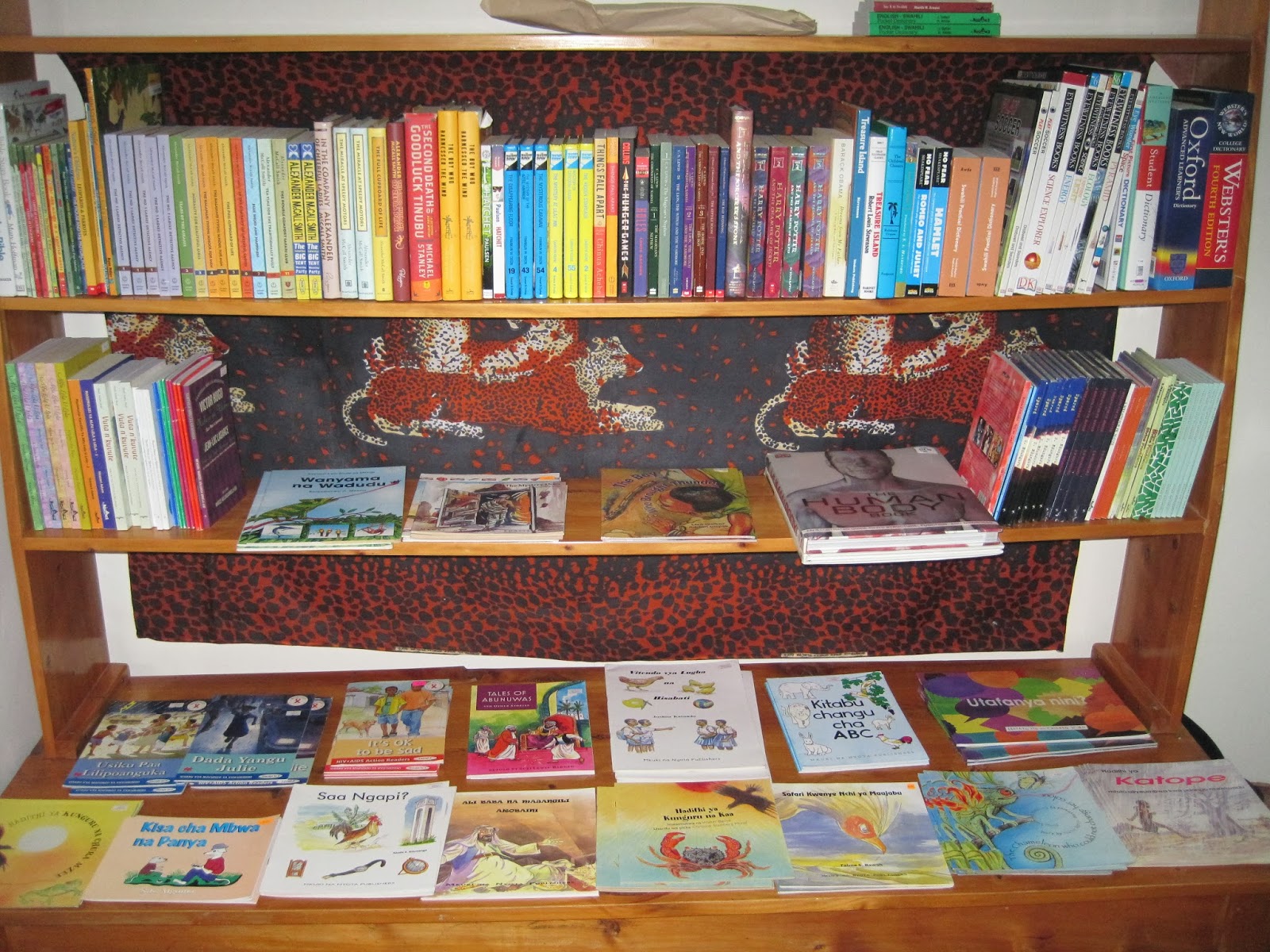
Our Church donated funds to start a library in our partner village of Kising'a.  We especially want young Children to start learning the joys of reading.  I visited TPH Bookstore in Dar which stocks books from a publisher, Mkuki na Nyota (Spear and Star), that is producing high quality books in English and Kiswahili at affordable prices for the Tanzanian market.  I purchased a nice selection of Children's picture books in Kiswahili and books for older children in both Kiswahili and English.  The thin picture books cost 4000 tsh ($2.50) and the larger books ranged in price from 6500 to 10,000 (~$4 to $6).   Several of the children's books are available in both Kiswahili and English and I will bring back some books when I go home.

TPH Bookstore on Samora Ave
Bookshelf of Mkuku Na Nyota books, don't you wonder about Kisa cha Mbwa na Panya (Story of the Dog and Rat)

The Chameleon who could not change her Colour, click to enlarge photo to read English version
"My Sister Julie"  HIV awareness story book in Kiswahili
English version of My Sister Julie, click to enlarge to read.
Saa Ngapi (What time is it?)  Saa Moja means 1 AM.  Notice the clock, in Kiswahili our 7 AM is 1 AM because that is the first hour of the day in a place on the equator where the day is about 12 hours all year long.  Maya is having chai (tea) and mkate (bread).
Books from TPH on the lower shelf and table top, books I brought from home on the top shelf.  Click to enlarge photo if you want to read titles. (warning large photo)
TPH is conveniently located on Samora Ave between Mkwepu and Azikiwe Streets.  3 blocks away, on Ohio and Sokoine, is Steers, a western style food court with hamburgers, pizza, salad, and Chinese food stations.  Within walking distance are the National Museum (which is really worth visiting), the beautiful bright yellow downtown Lutheran Church on the harbor, the fish market, and the Zanzibar ferry terminal.  Our BKB groups could have a nice day in Dar visiting the National Museum and TPH Bookshop with lunch at Steers.  This also might be a nice way to recover from jet lag with an easy day before the long drive to Iringa.

TPH Bookshop on Facebook 
Mkuki na Nyota Publisher Children's online catalog

Wednesday, October 17, 2012

Mtera School Visit

The last school to visit was Mtera.  Mtera Secondary School is in the rift valley and is near the Mtera Reservoir which has a major hydroelectric dam.  The school is about 3 hours from Iringa on the road to Dodoma, the formal capital of Tanzania (Dar is the effective capital).  A Chinese construction project is reconstructing the road to Dodoma which is a rough dirt track and construction was taking place almost the entire 120 KM to Mtera.

Semi wild Kanga birds hanging around the teacher houses
Water tank filled from deep well
Baobab tree near the headmaster's office
 It is very hot and dry in Mtera and fortunately, it is the only DIRA school with electricity because of their location near the hydroelectric dam.  They have a deep well with an electric pump that fills a concrete tank for their water supply.  Unfortunately, monkeys have opened up the protective screen and are using the tank as their private indoor swimming pool.  They need to secure the tank better and also get a larger capacity pump to provide enough clean water for the school.

The school is preparing rooms for a Global Volunteers visit in December.  These accommodations would be useful for BKB volunteers as well.   Mtera would be a good school for installing computers because they have electricity.
Henry (facing on right) with students doing analysis


I met with science teachers again and we prepared solutions and did the volumetric analysis practical with students.  The science teacher, Henry Msungu, was from Kising'a and had attended Kising'a Secondary for O level and Songea Boys for A level.  Although Henry was a Form VI graduate, he was competent in the laboratory.  The other teachers were practice teachers temporarily at Mtera.  I also met with the English teacher and left materials with him.  Mtera has 15 teachers and a relatively new Headmaster who appears to be making a difference at the school.


Five Year improvement plan for Mtera
The next morning we drove down to the reservoir and watched fishermen in dugout canoes bringing in a net.  The water in the reservoir is very low and the headmaster said that is due to increased use of water upriver for rice irrigation.  At some point, the low water will impact electricity generation.  We left early for Iringa before it got too hot and we lost our breaks because of a broken hydraulic line.  The line was a metal tube and the solution was to crush the broken tube with rocks and add more fluid to restore the pressure so the breaks at least worked partially.  While we were wondering if we would spend the night in the bush, we were passed by a Massai and a cart pulled by two donkeys who had no mechanical difficulties.  

Fisherman on Mtera circling a net

Everyone who goes to Mtera must bring back fresh fish, not sure how fresh these will be after a 3 hour drive through the Rift Valley
The more reliable donkey transport passing our car with a broken brake hydraulic line

Wednesday, September 26, 2012

Kising'a Visit

I went to Kising'a last Friday to visit our partner village.  The car I rented has a bad clutch that sometimes would not engage in any gear when the car is stopped.  A couple times it took about 5 minutes of trying to finally get it in gear and I thought I might be stranded.  Much of the ride does not have cell reception but there are quite a few vehicles on that road.  On the way, I picked up two men and two women heading to Kising'a and Isele.  This caused quite a bit of amusement when I arrived in Kising'a with two men who did not speak English.  That night at the house they must have laughed about it for more than 5 minutes wondering how we communicated.  It is nice to be back in Kising'a and Pastor Candidate Peweni, from Tumaini, was still there and she helped with English and is a delight to be with.

Pastor Wihale's living room decorated for my arrival.
Last Christmas, Sue and I brought a small solar power system for the Pastor's house that would charge a battery during the day to run two small fluorescent bulbs and three LED lights.  It can also be used to charge cell phones.  The family has decided that this last feature is more important than having light and they are using the system to charge phones for people in the village.  People pay 500 shillings to charge a phone and they can charge about 10 in a day, thus making up to 5000 shillings a day or a little more than $3.  This is another lesson that how we think about things is not how a Tanzanian might think about things such as the importance of having solar lights at night when you could use a candle.

Phone charging station with universal adapters.
I arrived mid afternoon and watched a football game between Secondary School students and the village.  I met a group of Form I and II girls from the Secondary school and was pleased to hear pretty good English.

Secondary School girls shouting Safi! meaning Fine! for every good play.
 
Younger spectators eager to have their picture taken and see it on the camera.


The next morning, we went to the preaching point of Kidamuka to see the new church they have been building.  I didn't trust the car so we used the shortcut foot paths which take you down one steep slope and up another.  We passed a tree nursery for pine seedlings.  Kising'a people plant pine trees to harvest for lumber and the parish has been harvesting their forest to pay for church construction along with our donations. Recently, a company called New Forests has come to Kising'a to plant larger tree plantations.  They built a new maternity ward at the dispensary for a benefit to the community.  This is probably a mixed blessing because the landowners in Kising'a will not benefit as much as they would planting trees themselves.
Pine cones drying to produce seeds for planting.
Tree nursery in the valley where water is available.
Pastor Wihale, Peweni and evangelists in front of Kidamuka church.
Peweni on my right and Wihale on my left inside the freshly painted church.

Flower and unripe fruit of naturally growing Passion Fruit on the shortcut path.

This poor thing grazing in a burr patch with a beard of burrs.  Reminded me of my dogs.


 Kising'a parish was having a special Marriage, Family, and Children program that weekend led by Peweni and Pastor Wihale.  Women from all the preaching points had gathered for the program and fellowship together.  The met in small groups to discuss family matters and did a lot of singing.


Women discussion group.


Preparing a sweet beverage from a local wheat like plant.  This same beverage can also be made alcoholic but of course not for the women's group.  Maybe we shouldn't complain about our Church kitchen.


Progress on the new Church at Madisi, the main preaching point of Kising'a. Lumber for the church from the parish forest was stacked at the Pastor's house and completion was expected by the end of this year.  Next step creating two concrete beams.

In the afternoon, we went to Kising'a Secondary school for the graduation of the Christian Student Fellowship Form IV students.  The school graduation will be next week.  The ceremony was a bit long but included a lot of singing and dancing.  They had a fun fund raising auction where people could bid on something to be given to others by saying the amount of the bid and the person it was for.  I bid on a soda for Peweni and then she turned around and did the same for me.  I met the headmaster and teachers the following morning.  The teachers are all Form VI graduates themselves so like many Tanzania Secondary schools you have high school graduates teaching high school students.  Brian, an American volunteer from Idaho had just arrived to teach English for at least 4 months and he might stay for as long as 2 years.  We met his sister Katarina last year when she was at Kising'a teaching English for 4 months.  VST acquired a lot of text books last year and Kising'a school is now well supplied.  The bigger problem is recruiting teachers with teaching degrees and teacher and headmaster turnover.  This is a common problem at most Tanzanian secondary schools and remote village schools are in a difficult position.

Student receiving her certificate with reusable garlands for the photo op.
Water is still an issue in Kising'a.  The pump we installed a couple years ago is not working because the seals need to be replaced.  Sargent, a student we sponsored, has found a natural spring high up a nearby mountain.  He built a water intake at the spring and laid about 2 KM of one inch pipe to bring water to the edge of Kising'a village using gravity flow.  The water looks pure and people have been drinking it with no ill effects.  This has a great potential for connecting to a central tank in Kising'a with distribution lines running to different parts of the village.  On Saturday, I will go back to Kising'a with the Iringa Region Water Engineer Byemerwa, a friend from past work at Image and Ipalamwa wells, to measure the elevation at the source and evaluate the flow of water available.  We will also try to bring someone from Kilolo Star to replace the seals in the pump.

Anna Wihale carrying a double stack of 60 lbs of water.

The source is on the ridge near the stand of Eucalyptus trees.  Pipe is laid from that point to just below where this picture was taken.
Sargent next to the end of the pipe with continuous flow of water.
Closer view of the crystal clear water flowing from the pipe.